
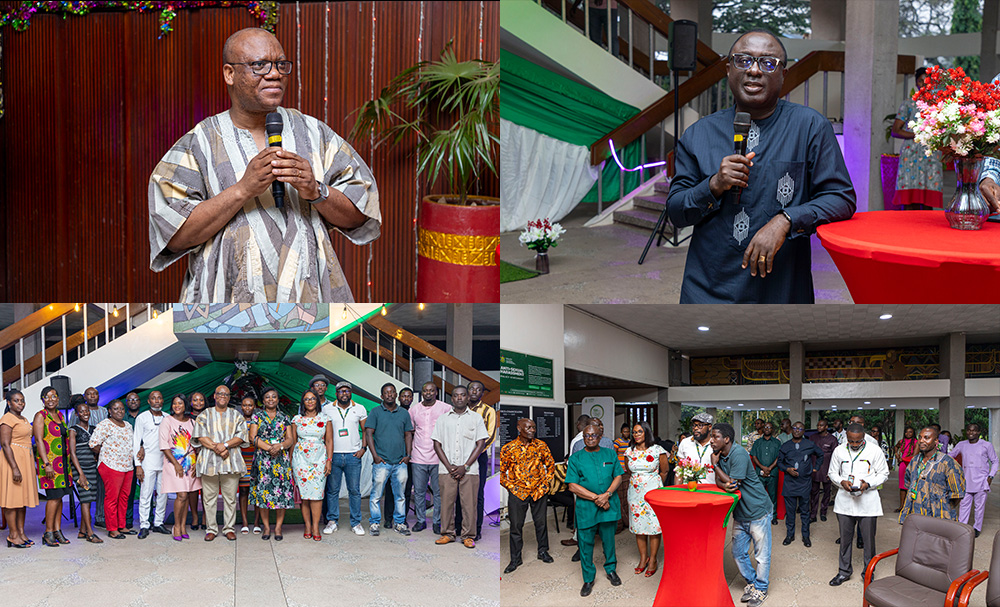
The Office of Grants and Research (OGR) of the Kwame Nkrumah University of Science and Technology (KNUST), Kumasi has held an end-of-year gathering to reflect on achievements across the University’s research and innovation ecosystem and to strengthen engagement with key stakeholders.
Speaking at the event, the Director of OGR, Professor Jerry John Kponyo, said the meeting was organised as a moment of reflection, appreciation and shared learning, stressing that success in research funding requires sustained effort.
“Anyone who has been involved in research and grants knows very well that money does not fall from the sky,” Professor Kponyo said, noting that securing funding often involves long hours and persistent work before any funds are credited to the University’s accounts.
He said the gathering provided an opportunity for researchers, administrators and partners to exchange experiences and learn from the perspectives of past leaders of OGR to help shape the future direction of the office. “It is always important to learn from the story of OGR so that we will be able to chart a path for the future,” he said.
The Pro Vice-Chancellor, Professor David Asamoah, speaking on behalf of University Management, commended staff of OGR and other research-support units for their behind-the-scenes role in advancing KNUST’s research agenda.
“When things are moving on, we often take it for granted, but there are people behind the wheel who make everything happen,” he said. “On behalf of Management, we want to say thank you. We are grateful for your efforts, and we do not take them for granted.”
Offering reflections as a past Director of OGR, Professor Peter Donkor traced the origins of the office to 2013, describing it as an offshoot of an international medical education partnership that exposed KNUST to structured grants management systems in other universities.
“At the time, KNUST did not have a coordinated grants office, and research funding was largely handled in isolation,” he recalled. He said this led to efforts to establish a centralised unit, supported by a special grant of about $300,000 and strong backing from University leadership.
Professor Donkor said that although the office was initially viewed with suspicion, it has grown into a trusted and recognised unit within the University, providing guidance on grant acquisition, management and post-award processes.
“It is encouraging to see that OGR is now a brand name, and people are no longer afraid of it,” he said, attributing the progress to the collective efforts of staff, early grant managers and successive leadership.
He called for sustained investment in grants management infrastructure, capacity building for administrators and specialised training to support KNUST’s ambition of becoming a leading research-intensive university. “As we draw in more funding, we must also be known for the quality and impact of our research,” he said.
Principal investigators present at the event also shared brief reflections on their research journeys, highlighting the role of OGR in grant acquisition and project management, and offered goodwill messages as the office continues to support research and innovation across the University.


